25th July 2025
The new law easing regulations on certain agricultural activities and practices has caused a furore in France.
The Loi Duplomb, officially named as a "law to lift the constraints on the exercise of the profession of farmer", is legislation proposed by Senator Laurent Duplomb (himself a farmer) and adopted earlier this month.
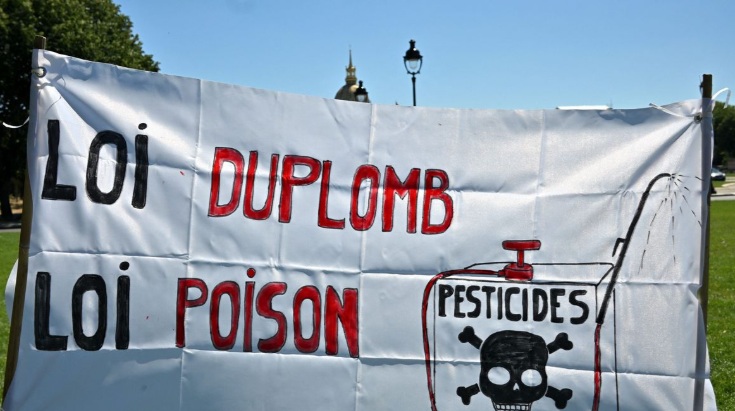
This law has sparked a lively controversy, with massive demonstrations and an online petition collecting nearly 2 million signatures against its adoption, a record. Petitions receiving more than 500,000 signatures from at least 30 departments can trigger a debate in parliament, although the process is not automatic.
The law was introduced in the context of an agricultural crisis in France, marked by a significant drop in agricultural production and incomes in 2024. The crisis caused widespread protests by farmers.
While the new law has been introduced at the behest of the predominantly large farm producers' union, the FNSEA, it is opposed by the eco-led union of small farmers, the Confédération paysanne.
One of the most controversial provisions is the reauthorisation of the use of certain pesticides, including acetamiprid, banned since 2018, but authorised in Europe until 2033. The substance is considered particularly toxic to bees, although the European Food Safety Authority state that “there are major uncertainties in the body of evidence for the developmental neurotoxicity properties of acetamiprid and further data are therefore needed to come to a more robust mechanistic understanding.” The measure has been demanded, in particular, by sugar beet producers, who say they have no effective alternative to protect their crops.
The regulations governing the use of the pesticide have yet to be published, but it can only be used in the event of a "serious threat to agricultural production" and in the absence of sufficient alternatives. As usual, therefore, the devil will be in the detail. UPDATE August 2025: The Constitutional Council ruled that the reintroduction of this pesticide is illegal so it has not been included in the published law.
Secondly, the law simplifies the procedure for obtaining authorisation of livestock installations, facilitating the expansion or creation of intensive livestock buildings. It amends the town planning and environmental rules applicable to classified installations for environmental protection. In particular, it makes it possible to replace public enquiries, which are often long and complex, with mayoral meetings. The thresholds under which the installations would be subject to more rigid planning controls have been increased. Opponents consider larger installations will lead to higher levels of pollution and threaten the livelihoods of small livestock producers.
Finally, the law facilitates the construction of water storage ‘megabasins’ for agricultural irrigation and relaxes water abstraction rules. Once again, as with livestock installations, the administrative procedures are simplified. The law permits the basins to be considered a ‘major public interest’ project, thereby exempting them on regulations concerning the protection of endangered species.
Opponents consider that the basins amount to little more than the privatisation of the water supply. They fear that the increase in megabasins could lead to over-exploitation of water resources, endangering aquatic ecosystems and biodiversity. Nevertheless, the basins are not widespread in France, with only 1% of farmers connected to them.
Although the law has been adopted by the National Assembly it still has to pass the stage of the Constitutional Council. Left-wing groups in the National Assembly are contesting the legislative procedure followed for the adoption of text, and argue that the measure is contrary to the principle of precaution in environmental law.
The Constitutional Council will rule on the new law in early August.
Related Reading: