Capital Gains on Sale of French Property
A new report highlights the uneven nature of capital gains on the sale of property in France.


Capital Gains on Sale of French Property
20th April 2026
A new report highlights the uneven nature of capital gains on the sale of property in France.
The report, from the French Ministry of the Environment, is a review of capital gains on the sale of 600,000 homes in 2021.
The average sale value of the apartments was €130,000, and €200,000 for houses.
One of the report’s most striking findings is the wide variation in outcomes on capital gains. While real estate is commonly associated with steady appreciation, the data shows that outcomes differ widely.
Key findings include:
In 50% of transactions, the capital gain exceeded 18%;
In 31% of cases, the sale price was below the inflation-adjusted purchase price, with around one-quarter of all transactions recording a real loss of more than 6%;
A further 25% of properties were sold for nearly double their inflation-adjusted purchase price;
In 14% of the most favourable cases, sale prices more than tripled.
The median capital gain was higher for houses (33%) than for apartments (6%). This gap is partly explained by earlier average purchase dates for houses, when property prices were lower, even adjusted for inflation.
However, the figures do not take into account the costs incurred by the owner to improve the property, so some gains will not be the actual financial benefit to the owner.
A central theme of the report is the strong influence of real estate cycles on capital gains. Properties purchased during periods of high prices tend to generate lower returns, or even losses, when resold.
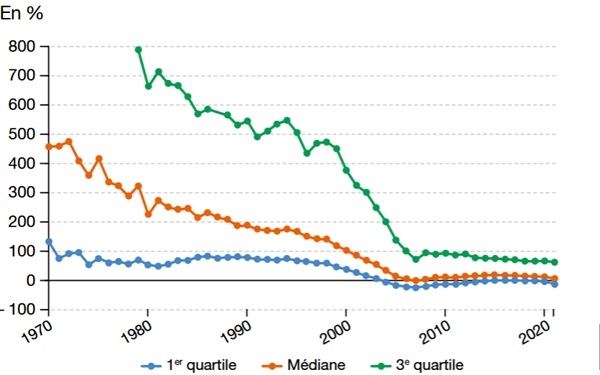
This is particularly evident for homes bought between 2006 and 2010, a period marked by strong price growth. When these properties were resold in 2021, they often produced weak or negative capital gains compared to properties purchased before or after that period.
The following graph shows how profitable it was to sell a house in 2021 depending on when the seller had bought it. The blue line shows the lower outcomes, the green line the upper end of outcomes, and the red line the median gain.
Another important finding concerns the duration of property ownership. On average, properties sold in 2021 had been held for about 12 years, slightly longer for houses than for apartments.
While longer holding periods generally increase the likelihood of capital gains, they also lead to greater variability in outcomes. In other words, the longer a property is held, the wider the range of possible gains or losses.
This variability is particularly pronounced for houses, especially those located in rural or sparsely populated areas. Some properties generate very high gains over a long period, while others perform poorly, reflecting local economic conditions and demographic trends.
The report highlights structural differences between urban and rural markets, as well as between apartments and houses.
Apartments tend to generate higher median gains in large urban centres, where demand is strong and housing markets are more dynamic. In contrast, gains are generally lower in smaller cities or less densely populated areas.
For houses, the situation is more complex. Median capital gains vary across territories but often hover around 30%, with higher variability in rural regions.
Unfortunately, the report does not offer a more detailed geographic analysis, although figures from INSEE, the national statistical agency, offer some assistance. Thus, between 2006 and 2021 in the major cities of France the house price index rose by an average of 60%, whilst in rural areas it rose an average of 10%.
As always, however, history is no predictor of the future, and in recent years, post-Covid, the tide has turned more strongly in favour of the rural housing market.
Related Reading:
You just read an issue of France Insider. You can also browse the full archives of this newsletter.