
11th April 2024
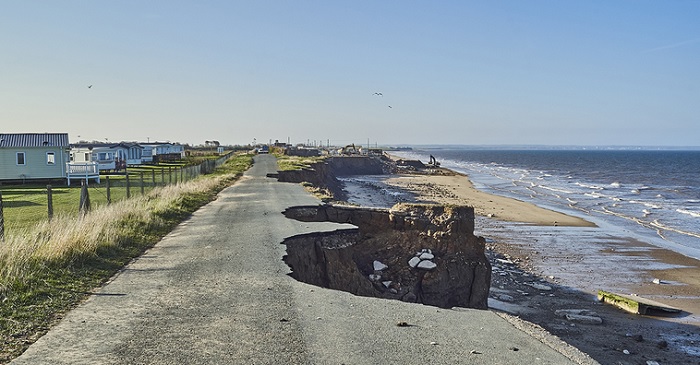
A new government report has identified 500 communes where coastal erosion could make certain areas uninhabitable.
To read the article you can take out a premium subscription for €20/YEAR at Subscribe to France Insider.
You can see the full catalogue of our articles at France Insider News.
If you no longer wish to hear from us simply unsubscribe using the link below.
Enjoy your reading,
The Team at France Insider

11th April 2024
A new government report has identified 500 communes where coastal erosion could make certain areas uninhabitable.
&
According to a report by the Centre d'études et d'expertise sur les risques, l'environnement, la mobilité et l'aménagement (Cerema) around 500 communes along the coastline of France are likely to be severely affected by coastal erosion arising from climate change.
France is particularly vulnerable to the retreat of the coastline, which in areas is collapsing under the effect of natural phenomena (swell, wind), rising sea levels, as well as human actions.
The authors state that erosion is eating away at about 900 km of coastline. To anticipate its consequences, Cerema has drawn up three scenarios for 2028, 2050 and 2100.
In 2028, 1,046 buildings, more than half of which are residential, with a market value of "around €240 million", could be washed away by the sea.
"The position of the coastline will often depend more on the effect of storms (...) as well as the trend of chronic decline," the authors say.
By 2050, 5,208 dwellings could be affected, including nearly 2,000 second homes, worth around €1.1 billion.
By 2100, with the prospect of "complete disappearance of protective structures" and a "progressive flooding of all topographically low areas of the coast", 450,000 dwellings are potentially threatened, worth around €86 billion.
The study also identifies 1,437 business premises potentially affected in 2050 and 53,158 in 2100, as well as 15.5 km of roads in 2050, and 1,765 km of roads and 243 km of rail lines in the 2100 scenario.
The map below shows the number of buildings that may be swept away by the sea by 2050, followed by a map for 2100. All areas of the coast are affected, but notably La Manche, Vendée and the Mediterranean coast.


"This study shows that we must not wait to adapt and that the scenario of inaction, that of 2100, has an extremely strong impact both from an economic point of view and from our ability to live on coastal territories," commented Sébastien Dupray, director at Cerema, recalling that in the past 50 years "we have lost about 30 km², equivalent to 4,200 football pitches."
"There is no national solution that can be used everywhere in the country because the coasts of the Camargue are low and sandy, while the coasts of Normandy are high with chalk cliffs," he said, stressing that "barrages everywhere is not the answer."
The authors tend to favour nature-based solutions. These can be sandbanks, dunes or forests installed on dunes, or mangroves when the environment allows it. Vegetating the dunes allows the sediment to be fixed to the roots of the plants. The major advantage of such solutions is the preservation of biodiversity.
Christophe Béchu, Ministre de la Transition Ecologique commented that compensation and relocation to other locations in the commune "are solutions now on the table," advising residents concerned to go and see their mayor.
The minister stated that local plans would need to be revised on the basis of these new maps of threatened territories. Although most local councils have in place a risk plan (Plan de prévention des risques littoraux - PPRL) they will need to be updated.