
July 8, 2024, 7 p.m.

French Parliamentary Elections 2024

France Insider

France Insider

French Parliamentary Elections July 2024

8th July 2024

Despite widespread relief that the predicted electoral victory for the extreme right did not materialise, they made substantial gains, and there are choppy waters ahead for France.

To read the article you can take out a premium subscription for €20/YEAR at Subscribe to France Insider.

You can see the full catalogue of our articles at France Insider News.

If you no longer wish to hear from us simply unsubscribe using the link below.

Enjoy your reading,


The Team at France Insider

French Parliamentary Elections 2024

&

8th July 2024

Despite widespread relief that the predicted electoral victory for the extreme right did not materialise, they made substantial gains, and there are choppy waters ahead for France.

To the surprise of most commentators, it was the left-wing alliance (Nouveau Front Populaire - NFP) that came out ahead in the second round of the parliamentary elections, in terms of the number of seats, with the extreme right Rassemblement National (RN) relegated to third place.

However, behind the result there has been strong progress by Marine Le Pen's party.

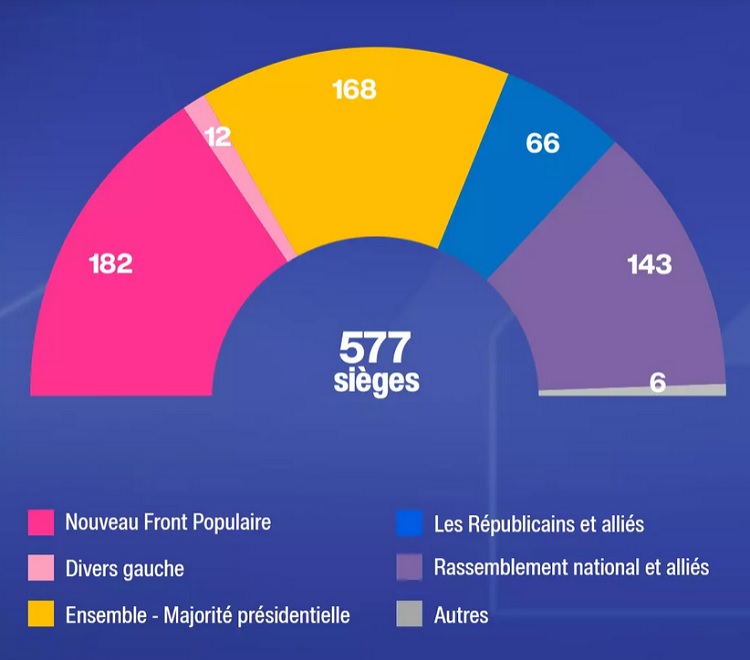
The left-wing bloc NFP now has the largest number of seats, with 182 deputies, to which can be added 12 various left-wing candidates outside the NFP.

The presidential alliance, called Ensemble, (Renaissance, MoDem and Horizons) have 168 seats. The RN and its allies won 143 seats. The Republicans kept 39 deputies, to which can be added a further 27 various right-wing deputies. The number needed for a majority is 289 seats.*

The success of the Ensemble and the NFP groups was made possible by the systematic withdrawal of NFP candidates who came third in their constituency and the less systematic but nevertheless massive withdrawal of Ensemble candidates in the same situation.

This configuration made it possible to block the RN in terms of the number of seats, but an analysis of the actual votes cast shows that the RN performed strongly.

This can be best shown by comparing Sunday’s results with those from 2022, which was itself a bit of a wake-up call for most mainstream politicians. In the 2022 parliamentary election the RN won 88 seats, collecting some 3.6 million votes. On Sunday the RN alone received 8.7 million votes, to which must be added the 1.3 million votes of its allies, for a total of 10 million votes. In two years, the far right has gained 6.4 million votes.

The other salient fact is that the number of votes obtained by the RN and allies exceeded those of all other parties. Their 10 million votes compare to 7 million collected by the NFP and 6.3 million to Ensemble. In percentage terms, the far-right coalition won 37% of the vote, compared to 25.3% for the NFP and 23.4% for Ensemble.

The only reason why the far right did not garner the seats was the withdrawal of candidates by the NFP and Ensemble.

The small relief on the higher number of votes for the far right was that with the withdrawal of candidates by the NFP and Ensemble, the RN fielded far more candidates, so would be expected to get more votes.

If the picture for the extreme right is illusory, much the same can be said about the left-wing alliance. Thus, whilst the extreme wing of the group (La France Insoumise) holds a majority of the seats (76 deputies out of 183), in fact their share of the seats did not increase in the second round; the main winner was the more moderate socialist party, who gained around 24 new MPs to take their total to 65. The ecologists within the NFP also gained 10 seats, taking their total from 24 to 34 seats. The communists lost seats, returning only 9 MPs.

Coalition or Chaos?

In the absence of a parliamentary majority in the National Assembly, the future is an uncertain one. The most likely scenario, already floated by President Macron before the elections, is a coalition of Ensemble and the Socialist Party, perhaps also with the addition of the ecologists, effectively therefore leaving the far left out in the cold.

However, that will require difficult decisions on both sides, as there are important policy issues on which they are diametrically opposed, such as pensions reform, a major issue in France. The trade unions may also have a view in the matter, with the one of the leading left-wing unions calling on President Macron to name a Prime Minister from within the NFP. They state they are 'mobilised' in the event that he does not respect the result, when the leader of the largest grouping in the parliament would expect to be nominated as PM. However, that is by convention, as it is not a constitutional requirement, and the NFP have been unable to agree on a leader.

Only one thing is certain; by law, President Macron cannot call further parliamentary elections until June 2025. He needs to find a way to govern the country until then.

For the time being Gabriel Attal, the existing Ensemble incumbent will continue as Prime Minister, whilst the structure of the new parliament unfolds and discussions take place behind the scenes about the appointment of a new Prime Minister who can command the confidence of MPs - and the country. Hold tight!

*Seat/group numbers subject to final confirmation.

Related Reading:
  • France Insider News

You just read an issue of France Insider. You can also browse the full archives of this newsletter.